
Equipment · EQP-2026-0002
Air Purifiers for Asthma and COPD: A Researched Buying Comparison
Summarised from published sources and cited below. Not medical advice — see the editorial policy.
Research disclosure — Researched comparison, not hands-on tested. This article is based on publicly available public-health guidance, published reviews and product-category research. We have not independently bought, tested or clinically evaluated the products mentioned. Brand names are examples for further comparison, not endorsements. This article is educational and is not personalised medical advice. Any future affiliate links should be clearly disclosed.
At a glance
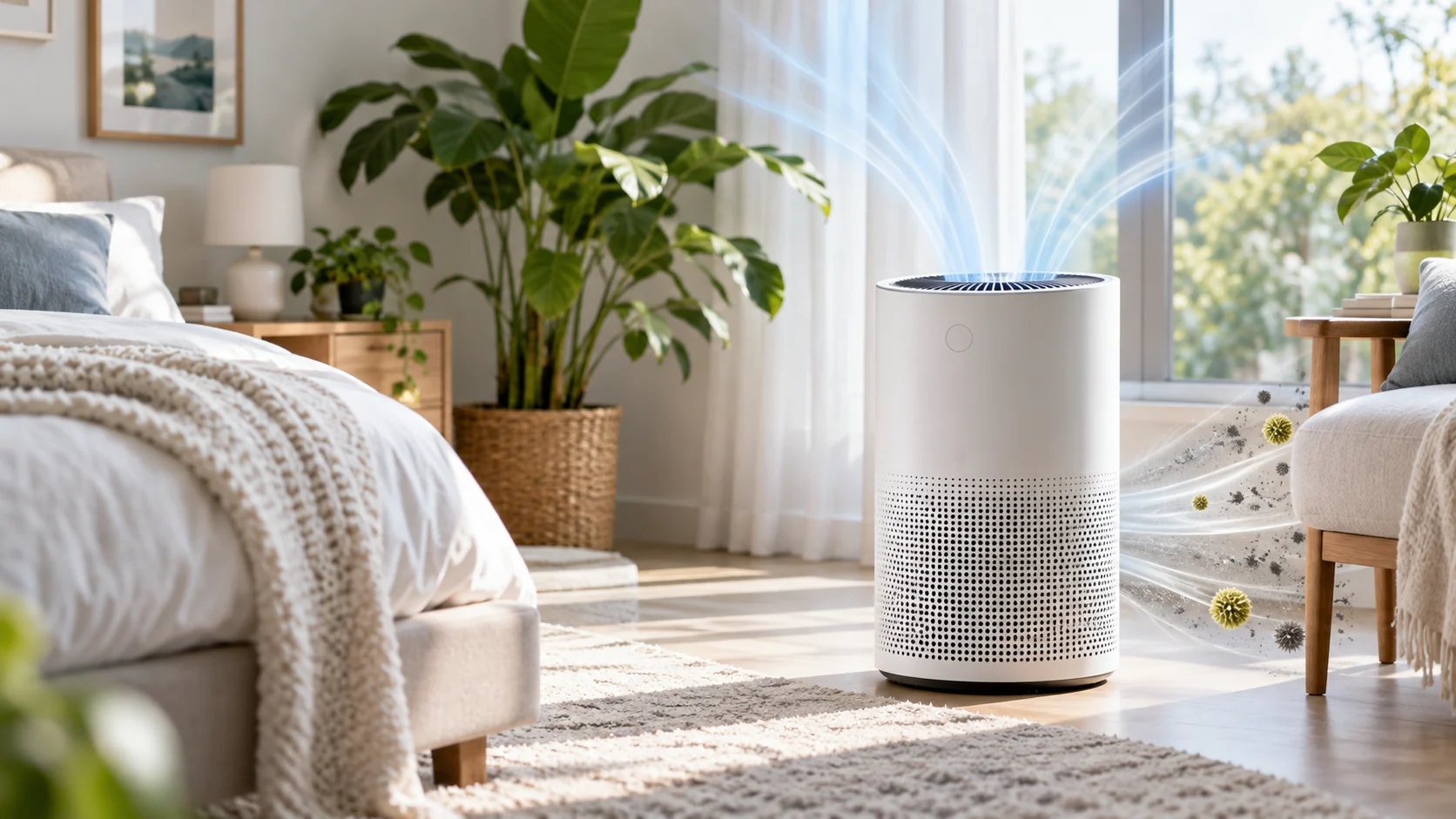
A well-chosen portable air cleaner can reduce airborne particles in a room. That can be useful when smoke, pollen or particulate pollution is a concern, but it does not treat asthma or COPD and cannot replace prescribed medication, ventilation or removal of pollutant sources. The US Environmental Protection Agency (EPA) notes that some studies suggest health benefits from filtration, while improvements in specific symptoms are not guaranteed.
Which technology matters?
| Feature | Useful for | What to verify |
|---|---|---|
| Mechanical HEPA particle filter | Airborne pollen, dust, smoke particles and some pet allergens | Exact filter specification and independent particle-removal testing |
| Clean air delivery rate (CADR) | How quickly the machine removes airborne particles | Smoke/PM CADR and the operating speed at which it was measured |
| Activated carbon | Some odours and certain gases | Quantity and type of carbon; a thin sheet may have limited capacity |
| Quiet continuous operation | Bedrooms and shared rooms | Noise at a speed that still delivers meaningful CADR |
| Available replacement filters | Real-world usability and cost | EU filter availability, price, replacement interval |
Avoid products that deliberately generate ozone in occupied rooms. Ozone irritates the lungs; a product marketed for “air purification” is not automatically appropriate for people with respiratory conditions.
How much CADR do you need?
For an ordinary rectangular room, calculate its floor area and ceiling height. As a simplified illustration, a 20 m² bedroom with a 2.5 m ceiling has 50 m³ of air. A purifier delivering 200 m³/hour of particle-cleaned air could theoretically deliver around four equivalent clean-air changes per hour in a well-mixed room (200 ÷ 50 = 4). This is a sizing illustration, not a guarantee: furnishings, placement, actual fan speed and incoming pollution change performance.
Compare units carefully: European products often state CADR in m³/h, while US comparisons may use cfm. An advertised “room size” without its target air changes and operating speed is a poor basis for comparing brands. A purifier is most useful when operated consistently; an impressive maximum CADR is less relevant if the noise forces you to select a much lower speed.
Researched comparison: purifier types
| Type | Main advantage | Main drawback | Potential fit |
|---|---|---|---|
| Compact bedroom purifier | Lower space requirement; potentially quiet | May clean large rooms too slowly | Small bedroom when CADR is sufficient |
| High-CADR fan-and-filter unit | Rapid particle removal | Larger footprint or higher-speed noise | Open living room or smoke events |
| Purifier and fan combination | Comfort and filtration in one appliance | Extra cost; fan function does not prove better filtration | Users who also need airflow |
| Purifier with substantial carbon stage | May help with selected odours and gases | Carbon saturates; gas claims need specific testing | Selected odour problems alongside particle concerns |
Brands in the accompanying supplier research include Levoit, Dyson, SharkNinja, Beurer and Trotec. They are research leads, not independently ranked winners here. Investigate the exact EU model rather than assuming specifications or filters match US reviews. HouseFresh and RTINGS publish useful comparative tests; methodologies can differ.
Respiratory-health perspective
An air purifier is a supplement, not a cure. Reduce exposure at source first: do not smoke indoors, use kitchen extraction when cooking, address damp or mould, and consider outdoor pollution when deciding whether to open windows. Filtration may lower exposure to airborne particles, but it will not remove settled dust mites from bedding, repair mouldy walls or reliably handle every gas.
People with asthma, COPD or other respiratory conditions should follow their individual clinical action plan. Seek urgent medical assessment for severe or worsening breathlessness, blue lips, confusion or symptoms that do not respond as expected to prescribed rescue treatment.
What to check before buying in Europe
- Confirm CADR in a standard unit, plus room size and ceiling assumptions.
- Look for independent particle testing and measured noise at useful speeds.
- Check filter cost, filter identity and stock in your delivery country.
- Confirm voltage, plug, warranty, return policy and local product support.
- Check whether an optional ionizer or plasma feature can be fully disabled; favour straightforward mechanical filtration.
- Budget for regular filter replacement and electricity.
Frequently asked questions
Will a HEPA purifier remove all allergens? No. It can filter airborne particles that pass through it, but allergens settled on floors and fabrics require source control and cleaning.
Does a purifier remove carbon dioxide? Ordinary HEPA filtration does not remove CO₂. Ventilation is the usual approach to elevated indoor CO₂.
Is a purifier enough during wildfire smoke? It can help lower indoor particles, but reducing smoke entry and following local public-health advice also matter.