
Equipment · EQP-2026-0003
Bagged vs Bagless Vacuums for Allergies: A Practical Comparison
Summarised from published sources and cited below. Not medical advice — see the editorial policy.
Research disclosure — Researched comparison, not hands-on tested. This article is based on publicly available public-health guidance, published reviews and product-category research. We have not independently bought, tested or clinically evaluated the products mentioned. Brand names are examples for further comparison, not endorsements. This article is educational and is not personalised medical advice. Any future affiliate links should be clearly disclosed.
The most important difference happens at disposal
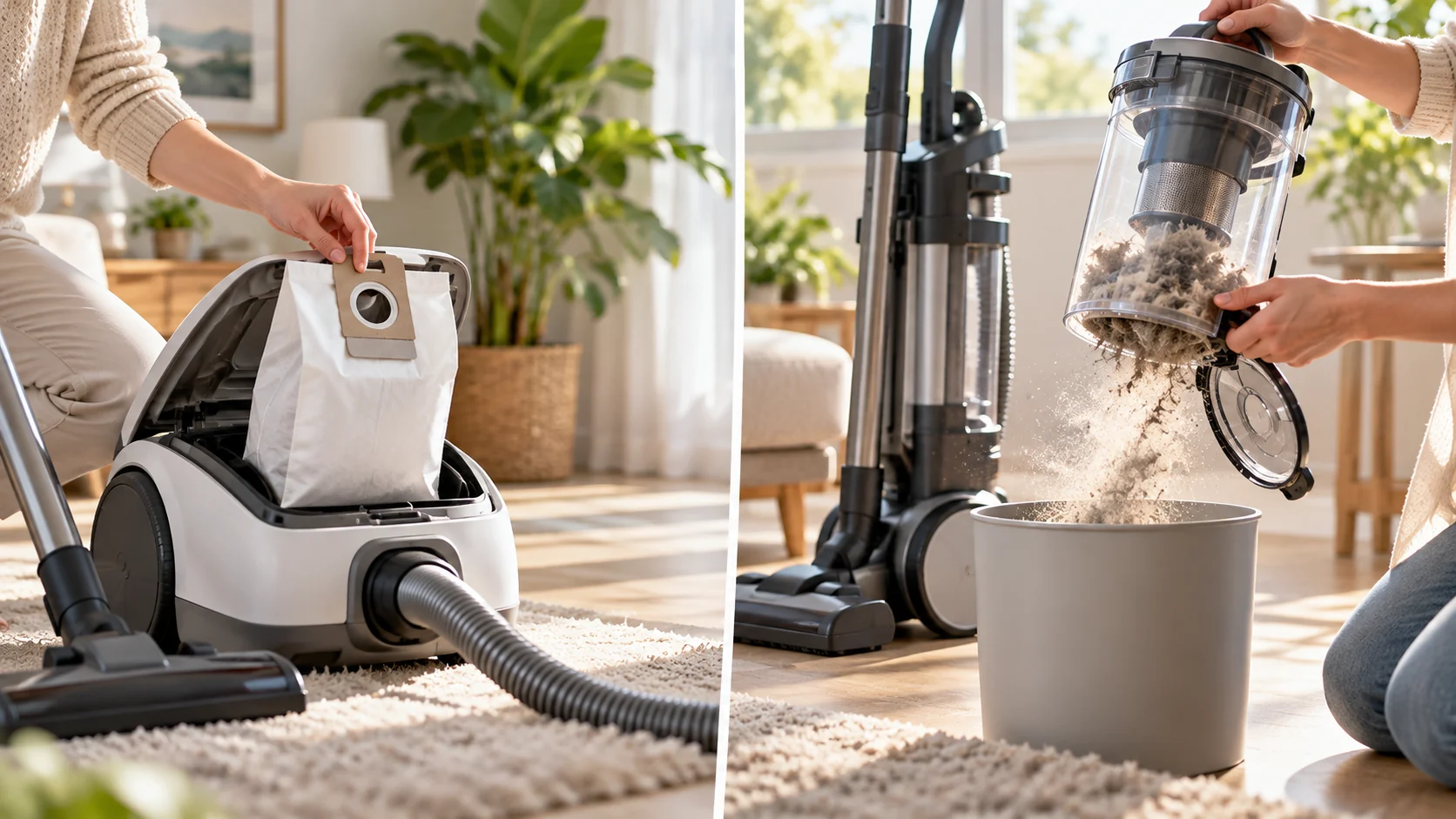
Both bagged and bagless vacuum cleaners can remove household dust effectively. For people concerned about allergen exposure, the key practical difference may be how debris leaves the machine. A bagged model with a self-sealing bag can limit direct handling of captured dust. A bagless model allows you to see collected debris and avoids disposable dust bags, but pouring or shaking contents into a bin can stir particles into the air.
Neither design automatically protects someone with asthma or allergic rhinitis. Poor seals, damaged filters, inadequate cleaning heads and careless emptying can undermine either approach.
Side-by-side comparison
| Question | Bagged vacuum | Bagless vacuum |
|---|---|---|
| Emptying | Remove and dispose of a closed bag; self-sealing versions can help | Open bin, tip or release debris; may require tapping or brushing |
| Consumable spending | Replacement bags plus any filters | Usually no bags; filters and parts still require maintenance |
| Visible dust handling | Often lower with well-designed sealed bags | Can be higher, especially with fine powder or hair |
| Convenience | Bags must be stocked | Bin can be emptied whenever needed |
| Performance as bag/bin fills | Depends on design and capacity | Depends on design, cyclone condition and filter loading |
| Allergy suitability | Often a sensible starting preference for sensitive households | May still suit if sealed and emptied away from occupants |
The table compares typical design trade-offs, not laboratory outcomes for specific machines.
What about HEPA filtration?
A HEPA exhaust filter captures small particles in the air stream passing through it, but allergy-relevant dust can leak elsewhere. Look for a sealed filtration system and third-party evidence of whole-machine containment. You should also verify whether the stated HEPA standard applies to the installed filter and whether the filter is user-replaceable. A HEPA label alone is not evidence that one product is safer than another.
When bagged is likely to make more sense
Bagged models deserve consideration where someone is highly sensitive to airborne dust, a household cleans large quantities of fine debris, or the person emptying the vacuum wants minimal contact with collected material. A bag that closes automatically when removed is a practical design advantage. The trade-off is ongoing bag availability and cost.
When bagless can be reasonable
A bagless machine can be practical for smaller homes or frequent short clean-ups, especially if it has demonstrably sealed filtration and a simple disposal mechanism. Empty it outdoors or in a well-ventilated location away from vulnerable occupants when practical, and avoid shaking the bin. Washable filters must be fully dry before reinstallation, following the manual.
Five checks before choosing
- Exact product and market version: EU and US names may conceal different accessories or internal components.
- Emissions evidence: Seek independent testing beyond advertised suction or filter grade.
- Dust handling: Watch a demonstration of real emptying and maintenance.
- Floor compatibility: Carpet pile, hard floors and stairs can alter usability dramatically.
- Long-term cost: Price bags, filters and repair parts over several years.
An often-overlooked factor is physical workload: a person with severe breathlessness may find a lighter canister or easy-gliding head more manageable than a heavy upright. This is a usability consideration, not a medical treatment claim.
Sources worth comparing
Not all evidence is equal here. Independent testing from reviewers such as RTINGS and Vacuum Wars is the most useful source for particle escape and pickup, because those are measured under controlled conditions. Owner discussions are worth reading for reliability, parts availability and recurring complaints about dust handling, but anecdotes should not be treated as measured failure rates.
Frequently asked questions
Are bagged vacuums always better for asthma? No. They may reduce handling exposure if designed well, but ventilation, whole-machine seals and cleaning technique still matter.
Does emptying outdoors solve every problem? No, but it can reduce the likelihood of releasing dust into occupied indoor spaces.
Can vacuuming replace allergen-proof bedding? No. Dust-mite management may combine bedding covers, washing, humidity control and cleaning.