
Equipment · EQP-2026-0006
Indoor Air Quality Monitors: PM2.5, CO₂, VOCs and Humidity Compared
Summarised from published sources and cited below. Not medical advice — see the editorial policy.
Research disclosure — Researched comparison, not hands-on tested. This article is based on publicly available public-health guidance, published reviews and product-category research. We have not independently bought, tested or clinically evaluated the products mentioned. Brand names are examples for further comparison, not endorsements. This article is educational and is not personalised medical advice. Any future affiliate links should be clearly disclosed.
What does an indoor air-quality monitor actually tell you?
A consumer monitor can reveal patterns—such as particle spikes during cooking or rising CO₂ in a crowded bedroom—but no single device measures every indoor hazard. The US EPA cautions that low-cost sensors vary in accuracy and are limited to the pollutants they are designed to detect. A colourful “air quality score” is often manufacturer-defined, not a universal health measurement.
The main readings explained
| Reading | Usually reported as | What it suggests | Important limit |
|---|---|---|---|
| PM2.5 | µg/m³ | Fine particles from outdoor pollution, cooking, smoke and other sources | Optical sensors can be affected by humidity and particle characteristics |
| PM10 | µg/m³ | Larger inhalable particles, including some dust | Low-cost PM10 readings can be less reliable for particular particle mixtures |
| CO₂ | ppm | Occupancy and adequacy of fresh-air exchange in many indoor settings | Not a direct measurement of viruses, toxins or oxygen saturation |
| TVOC | ppm, ppb or an index | Sensor response to a mixture of volatile compounds | Often cannot identify individual chemicals or their health risk |
| Relative humidity | % RH | Dampness and overly dry conditions | Depends on temperature and sensor placement |
| Temperature | °C | Comfort and context for humidity readings | Not a pollution measurement |
Carbon monoxide (CO) is different from carbon dioxide (CO₂). A general IAQ monitor with CO₂ does not replace an appropriately certified CO alarm. Smoke and CO alarms are separate safety devices with their own placement and maintenance requirements.
Choosing between three monitor styles
Particle-first monitor. Useful when tracking traffic infiltration, cooking aerosols, smoke and the response to a mechanical air purifier. Seek clear PM2.5 units, time-series charts and published sensor evaluation.
Ventilation-first monitor. A true non-dispersive infrared (NDIR) CO₂ sensor is a good candidate for identifying occupancy-related ventilation patterns. Check whether the specification says measured CO₂ rather than eCO₂, which is an estimate sometimes inferred from other sensors.
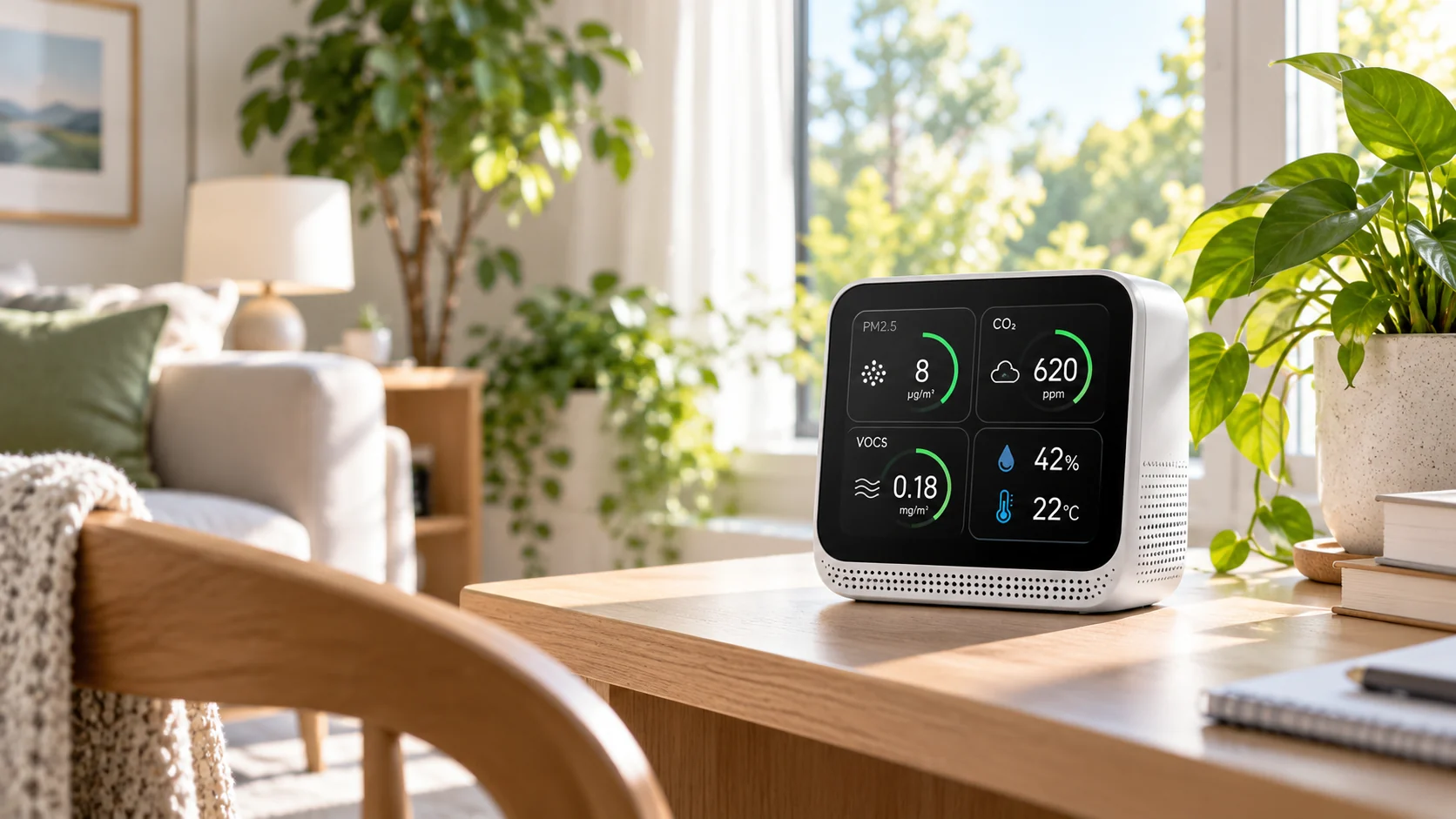
Multi-sensor monitor. Convenient for viewing particles, CO₂, temperature and humidity in one place, but more displayed metrics do not guarantee greater accuracy. Consider calibration, software support, data export and whether a vendor explains the TVOC scale.
How readings can guide practical steps
If PM2.5 spikes while frying food, use effective kitchen extraction and check whether your cooking practices are generating particles. If PM2.5 rises when outdoor smoke enters, consider source reduction and appropriately sized particle filtration. If CO₂ rises whenever several people occupy a closed room, evaluate safe ventilation opportunities and building-specific advice. If humidity repeatedly exceeds the recommended range, look for damp, condensation and moisture sources before purchasing a dehumidifier.
These examples show trends, not diagnoses. A sensor spike cannot establish why someone is wheezing; a “green” reading cannot demonstrate that the air is free of all hazardous substances.
Accuracy and placement
Place the monitor at approximately breathing height where air circulates naturally, away from the immediate plume of a stove, window, supply vent or humidifier unless you are intentionally studying that source. Note calibration procedures, sensor lifespan and whether firmware alters the displayed scale. Compare repeated patterns rather than treating one low-cost reading as laboratory evidence. If health symptoms are present, seek medical advice instead of adjusting treatment based on a monitor score.
Researched brand comparison approach
Your supplier research identifies AirGradient and Atmotube as specialist monitor manufacturers, and Conrad as a potential route for sensors. Before recommending any individual model, establish which pollutants it truly measures, whether it uses NDIR CO₂ or eCO₂, what comparison/validation exists, and whether replacement parts and EU shipping are available. User communities can help with firmware and reliability information; owner anecdotes do not establish sensor accuracy.
Frequently asked questions
Is CO₂ the same as an air quality index? No. CO₂ can help indicate ventilation conditions, while outdoor AQI systems generally combine or prioritise regulated pollutant concentrations.
Can a TVOC number diagnose harmful chemical exposure? No. Consumer TVOC sensors commonly respond broadly and cannot identify toxic compounds individually.
Does a low PM2.5 reading prove a room is safe? No. A particulate sensor does not necessarily detect gases, radon, carbon monoxide or biological hazards.